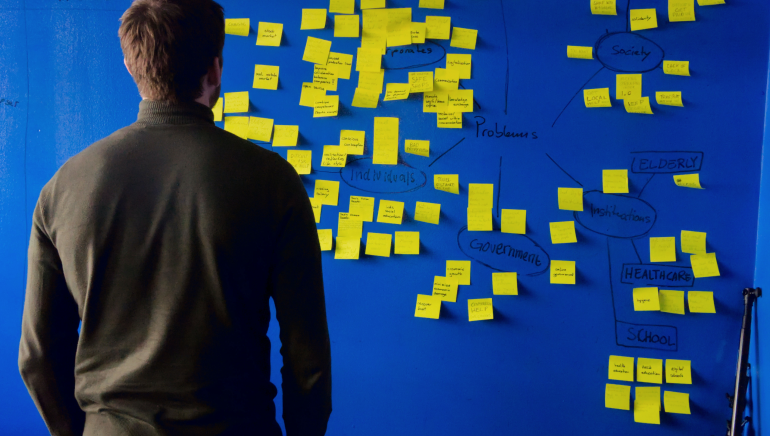
MVP stands for Minimum Viable Product. This is a product with just about enough features to attract consumers and justify a product idea early on in its development cycle. The idea is that you produce a very basic version of the actual product that you want to offer to the public and then watch the consumer’s interaction with the product / service. It doesn’t have to be anything too complicated – it could be something as simple as a landing page with all the relevant information, which gives the impression that it is fully automated when in fact, all the behind-the-scenes work is done manually. You could call this your ‘first version’ or a ‘stripped down version’ of the product. In doing this, you keep development costs down at the initial stages, giving you an opportunity to gauge the product’s viability.
When you are in the initial stages of product development, you need to make sure that costs are kept down for as long as possible, until the product / service can start to pay for itself and hopefully, recover your initial investment quickly. The last thing you want to do is to invest a large amount of time and funds into a product that then isn’t viable and doesn’t offer you a return.
The idea behind an MVP is to do the least amount of work possible in the early stages so that you can avoid putting a lot of resources into a product that may potentially not be as successful as you may have hoped. Just because you think it’s a good idea, it doesn’t mean that this is the majority opinion. This is where knowing how to determine a minimum viable product can help you.
Going through the MVP process will allow you to receive user feedback quickly, find out the product’s strengths / weaknesses and to use this information for product development. By starting on a small scale, taking cues from the users and learning from them, you can then create the best version of your idea with the least amount of effort.
This concept has proven to be very popular with many start-ups worldwide when they were in the early testing stages. Many world-famous companies went through this exact process before launching their full version websites and making their millions. Their methods were simple, varied, and successful in their execution. Here are just a few minimum viable product examples:
Dropbox opted for producing a simple short video which demonstrated how easy it would be to use a file-sharing platform. This resulted in an overnight waiting list of 75,000, all waiting for the beta version, thus validating the hypothesis.
Facebook on the other hand went for a basic platform that allowed students from the same classes to post messages to shared boards and therefore, stay connected. Using this method, Zuckerberg managed to validate his idea with feedback from a very narrow segment of the market, before launching on a larger scale.
The founders of Airbnb used their own apartment as proof of concept. They created a very simple website where they posted photos and details about their property. It wasn’t long before they had a long list of paying guests and we all know how successful this simple idea became!
Just as with the above, there are many other examples of well-known and world-famous brands that started off in this way. MVPs help product managers validate their ideas with real-life data and therefore, test their product before building the ‘real deal’. This process is the shortest route with the most value to your first customer base. It saves time and money and reduces time-to-market when it comes to releases of new features further down the line.
Make sure your planned MVP aligns with your business objectives & strategic goals. Have you set a revenue target? What is its purpose? Will it attract new users? These are the initial questions you need to ask yourself before you start the journey. If it doesn’t fit in with your current goals, you may want to shelve it and come back to it at a later stage – when it fits in better with your objectives further down the line.
If you decide that the idea is a good fit with your current business needs, you should then set about identifying specific problems or improvements you want to enable for your user persona. Think carefully about the solutions your users may be looking for. You will need to be strategic when it comes to deciding the limited functionality to include in your MVP. As a starting point, you should look at user research and competitive analysis, in order to come up with a basis for the decision on the product functionality at this stage. Also, consider the costs of implementation.
Once you’ve considered the above points, it’s time to come up with a development plan. The product must be viable as well as providing a high-quality user experience. You must be able to sell it as a product!
Plan: In order to build an MVP, you first need to draw a map of your ecosystem – a diagram that displays all of your likely product users. Next, you need to identify what it is that your users will get from your product – the product’s value.
Revenue and Distribution: Once you have taken these initial steps, it is important to define where your revenue is coming from and how you are going to distribute your product.
Value: You will then need to define the value proposition for each stakeholder within your ecosystem. What will they gain and what are they willing to give in exchange? At this stage, you should also consider what are your users’ biggest pains and where you can add the most value.
Success Criteria: Now that you have gone through the planning, finances, distribution and value stages, you need to establish your expectations. What does the final MVP look like? What will the user pay for using the MVP? These are the questions you need to answer before moving forward.
Identify the risks: As we all know, we don’t live in an ideal world and so, it makes sense to identify potential roadblocks and points of failure early on. In doing this, we can help reduce the risk of failure and financial loss before building a full-scale product.
Create your value path: Remember, this is not a race, it’s a journey. So, map out the customer discovery journey that will take you from where you are today to your final MVP. To do this, you will need to make some assumptions. Consider customer development interviews and prototype features as one way to collect data for these assumptions. Up to now, you have been assuming that there is a market for your product but, you need to test this out to see if you are right. One way to do this is to create a simple landing page and track click buttons.
The final product: After you have done all the above, if you conclude that there is a market and that yours is a viable product, prove it by offering freebies and monitoring the response to this. If the response is positive, you can then start building the full-blown product.

Misunderstanding: There is a common misuse of this term by teams who don’t fully understand the intended MVP meaning or its use. Many believe that an MVP equates to the smallest amount of functionality they can deliver, without the additional steps in the MVP building process.
Uncertainty: There may also be some confusion between an MVP (focus on learning) and a Minimum Marketable Feature (MMF) or Minimum Marketable Product (MMP) – both of which focus on earning. This is not too big a problem and shouldn’t cause too much harm, provided the focus is right – delivering a product that meets the customer’s needs, thus achieving customer satisfaction.
Attention to detail: Another common occurrence is when teams put too much emphasis on the ‘minimum’ part of MVP and not enough on the ‘viable’ part. The result is a product that is not of sufficient quality to provide an accurate assessment of whether customers will use the product.
Customer feedback: Many deliver what they believe is a great MVP, but don’t then take into consideration or act on the user feedback. In ignoring this feedback and not making any further changes to the product, their product is much less likely to succeed or may not succeed at all.
Taking all the above into consideration, it’s safe to say that MVP is a proven concept which, when done correctly, can bring many benefits to a business. Not only will it save time, money and energy, but it will also allow you to build and develop a product that fits in with what the market wants and is more likely to succeed – the best version possible!
If you want to give MVP a try but feel that the process is a little bit overwhelming, a startup studio can support you along the way, putting their expertise at your disposal, and helping you achieve your desired results.